
How to Source Cashew Nuts: A Buyer's Guide for Industrial and Commercial Procurement
A practical guide for food manufacturers and trading companies on sourcing cashew nuts: understanding the supply chain, grades, Incoterms, quality certification and working with cashew nut suppliers.
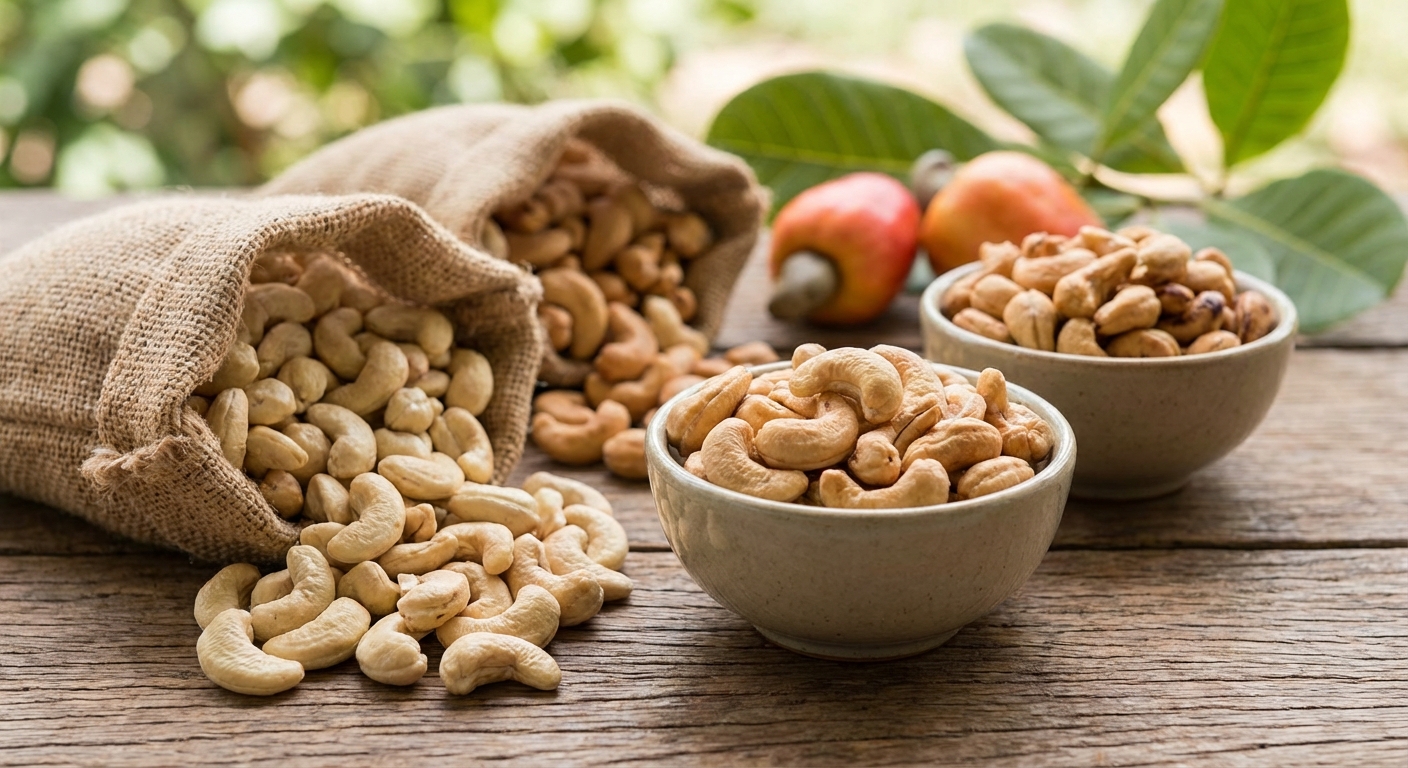
Sourcing cashew nuts at commercial or industrial scale is materially different from buying retail. The global cashew supply chain is complex — raw nuts grown in West Africa travel to Vietnam or India for processing before reaching European or North American buyers — and each link in that chain introduces price risk, quality variability and lead time uncertainty. This guide is written for procurement managers, commodity traders and food manufacturers who want to build a robust, cost-effective cashew supply strategy.
Step 1: Define What You Are Buying
Before approaching any cashew nut supplier, you must define the product specification precisely. The wrong specification costs money in both directions — over-specification pushes price up; under-specification invites quality failures.
Raw Cashew Nuts (RCN) vs. Processed Kernels
RCN is the unshelled nut as harvested, typically traded in 80-kg jute bags. It requires industrial-scale processing (roasting, cracking, peeling, grading) before it is edible. RCN buyers are typically processors in India or Vietnam, or vertically integrated manufacturers with their own shelling facilities.
Processed cashew kernels (W-grades) are the shelled, graded, vacuum-packed product ready for food manufacturing or direct consumption. This is what most food manufacturers, snack companies and confectionery producers should specify.
Kernel Grade
The international W-grade system classifies kernels by size (pieces per pound) and colour:
| Grade | Size | Typical use |
|---|---|---|
| W-180 | Largest whole | Premium snack, gift packs |
| W-210 | Very large whole | Premium snack |
| W-240 | Large whole | Retail snack, ingredient |
| W-320 | Medium whole | Highest volume; snack, confectionery, bakery |
| W-450 | Small whole | Industrial ingredient, paste |
| LP / SP / DW | Pieces, splits, dessert wholes | Baking, granola, paste, milling |
For most food manufacturing applications (chocolate inclusions, granola bars, nut pastes, ready meals), W-320 offers the best combination of yield and price. For premium snack or retail packs, W-240 or W-210 may justify the premium.
Colour Grade
Within each size grade, kernels are further classified by colour:
- Pale White (PW): the lightest, most premium colour
- White (W): standard pale cream
- Scorched Whole (SW): slight darkening from processing, acceptable for most food uses
- Desert Whole (DW): more visible darkening, typically used for industrial processing or milling
Specify colour carefully: a paste or butter application is better served by DW (lower cost, colour irrelevant) while a premium confectionery inclusion requires PW or W.
Step 2: Understand the Supply Chain Geography
Origin: West Africa
West African RCN — principally from Côte d’Ivoire, Guinea-Bissau, Tanzania and Ghana — represents approximately 45–50 % of global production. Côte d’Ivoire alone exports over 700,000 MT of RCN annually. The harvest window is March–June in West Africa.
West African nuts are characterised by:
- Good kernel outturn (45–52 lbs per 80-kg bag)
- Competitive pricing relative to Indian domestic crop
- Some variability in moisture and aflatoxin depending on harvest conditions
Processing: Vietnam and India
The majority of West African RCN is shipped to Vietnam or India for processing. Vietnam dominates large-scale mechanised processing; India (particularly Kerala) operates more labour-intensive facilities but with long experience in quality control.
Vietnamese-processed kernels typically carry better price-to-quality consistency for W-320 and W-240 grades. Indian processors often excel in artisanal or premium grades.
Buying Processed Kernels vs. RCN
For food manufacturers, buying processed W-grade kernels (CIF Rotterdam, CIF Houston, or CIF your destination port) is almost always the right choice. You avoid:
- Processing capital cost
- CNSL handling and disposal (the toxic resin creates significant HSE obligations)
- Grade variability at outturn
- Working capital locked in processing inventory
Buy RCN only if you have a captive processing operation or are a trading house taking a price position.
Step 3: Qualify Your Cashew Nut Suppliers
Supplier qualification is the most important risk management step. The cashew supply chain has significant adulteration and food safety risk if sourced without due diligence.
Food Safety: Aflatoxin
Aflatoxins (B1, B2, G1, G2) are the primary food safety concern in cashew nuts. EU Regulation (EC) 1881/2006 and its amendments set:
- Aflatoxin B1: ≤ 5 ppb (µg/kg)
- Total aflatoxins: ≤ 10 ppb
Non-compliant shipments are notified in the EU RASFF system and face destruction or return. Require pre-shipment analysis certificates from an accredited laboratory (ISO 17025), ideally using HPLC-MS/MS or immunoaffinity column methods.
Physical Quality: KOR and Outturn
For RCN buyers, the key quality metric is Kernel Outturn Ratio (KOR) — the pounds of kernel produced per 80-kg bag. This directly determines your effective kernel cost per tonne. Reliable suppliers provide pre-shipment KOR analysis; insist on this for every lot.
For processed kernel buyers, request:
- Moisture content (≤ 5 % for vacuum-packed kernels)
- Broken kernels percentage (W-grade tolerates ≤ 5 % broken)
- Foreign matter (nil)
- Packaging integrity (vacuum retention after 6 months)
Certifications to Request
Depending on your market and customer requirements:
| Certification | Relevant for |
|---|---|
| FSSC 22000 / BRC / IFS | All food-grade supply |
| Organic (EU/NOP) | Natural and organic food manufacturers |
| Fairtrade | Ethical sourcing commitments |
| Rainforest Alliance | Sustainability-linked procurement |
| Halal | Middle East, South Asian retail |
| Kosher | Jewish market, US natural channel |
All certifications add cost (10–40 % premium for organic) and require supply chain traceability documentation. Plan certification requirements at least one crop cycle (12 months) ahead of your commercial launch.
Step 4: Structure the Commercial Terms
Incoterms
The most common Incoterms for cashew kernel trade are:
- CIF (Cost Insurance Freight): seller arranges freight and insurance to your named port. Ideal for buyers without strong freight relationships. Standard for most European and North American buyers.
- FOB (Free On Board): seller loads at origin port; buyer arranges freight. Better for buyers with strong forwarder relationships or who consolidate multiple origins.
- DDP (Delivered Duty Paid): seller delivers to your door, including import duty and VAT. Convenience comes at a premium — typically 8–15 % above CIF.
For first transactions with a new supplier, CIF provides cleaner risk allocation. Once you understand transit patterns and lead times, consider FOB to capture freight market opportunities.
Payment Terms
Industrial cashew trade typically operates on:
- Letter of Credit (LC) at sight or 30–60 days — standard for first transactions and large volumes
- 30–60 day open account (OA) — available to established buyers with credit history
- Advance payment (20–30 %) for custom grades, organic, or small-volume spot orders
Avoid 100 % advance payment for large orders unless the supplier has substantial trade finance history and you have independent quality inspection (SGS, Bureau Veritas, Intertek) arranged pre-shipment.
Pre-Shipment Inspection
For all orders above approximately 5 MT, commission a pre-shipment inspection from an independent inspection company. The inspection should cover:
- Moisture and water activity
- Visual grade assessment
- Aflatoxin analysis (send to accredited lab)
- Container stuffing supervision (pest exclusion, moisture barriers)
- Seal verification
The cost (approximately USD 300–600 per container) is negligible against the cost of a rejected shipment.
Step 5: Manage Lead Times and Seasonality
Cashew procurement is seasonal. The West African harvest runs March–June; Indian domestic production peaks December–March. Vietnamese processors run year-round but their input cost follows the Ivorian crop calendar.
Key timing implications for buyers:
- March–May: New-crop RCN available in Abidjan. Prices typically at seasonal low for the coming supply year.
- June–September: Processors in Vietnam/India running at capacity on new-crop RCN. Good time to confirm forward kernel contracts for Q4 delivery.
- October–December: Inventory depletion period. Spot prices rise. New-crop RCN arrives late December from early-harvest regions.
- January–February: Pre-season period. Limited spot availability. Buyers without forward contracts pay a premium.
Building a 6–9 month forward purchase contract for your base volume requirement is standard practice among industrial buyers. Leave 20–30 % of your volume for spot purchasing to capture seasonal lows and grade flexibility.
Working with CarverAgri as Your Cashew Supplier
CarverAgri sources cashew nuts directly from licensed exporters in Côte d’Ivoire, Guinea-Bissau and Tanzania, and works with verified processors in Vietnam and India for kernel supply. Our standard offering includes:
- W-320, W-240, W-180 whole kernel grades in vacuum-packed 25-lb tins or 11.34-kg tins
- LP and SP pieces for manufacturing applications
- Conventional and Fairtrade-certified grades (Guinea-Bissau origin)
- Pre-shipment aflatoxin and grade analysis with every shipment
- CIF European ports with standard 21–28 day transit from Abidjan or Ho Chi Minh City
Lead times: 4–6 weeks for standard grades from stock; 8–12 weeks for certified or custom grades.
Explore our Cashew Nuts product page for current specifications, or contact our sourcing desk with your grade, volume and destination port for a formal quotation within one business day.
Common Mistakes in Cashew Procurement
1. Buying on price alone. W-320 from different origins and processors varies significantly in colour, moisture and kernel integrity. Price comparison requires identical specification.
2. Skipping pre-shipment inspection. A single rejected container can cost more than five years of inspection fees.
3. No forward cover. Buyers who purchase 100 % spot can face 30–40 % price swings in a single year depending on the West African harvest.
4. Wrong grade for the application. Specifying W-240 for a paste or butter application adds cost with no functional benefit. Specify LP or DW.
5. Ignoring lead times. Certified grades (organic, Fairtrade) require 8–12 weeks from order to port. Planning too late forces you into spot market premiums.
Conclusion
Sourcing cashew nuts at industrial scale is a procurement discipline, not just a price negotiation. The buyers who build the most resilient, cost-effective supply chains are those who define specifications precisely, qualify suppliers rigorously, structure commercial terms correctly and manage the seasonal calendar proactively. If you are entering cashew procurement for the first time, or looking to diversify away from your current cashew nut supplier, contact CarverAgri — we will guide you through origin selection, grade choice and commercial structure to match your specific production requirement.