
Where Do Cashews Come From? History, Origins and Global Trade
Trace the cashew nut from its origins in northeastern Brazil to its dominance across West Africa, India and Vietnam — and learn what drives global cashew supply today.
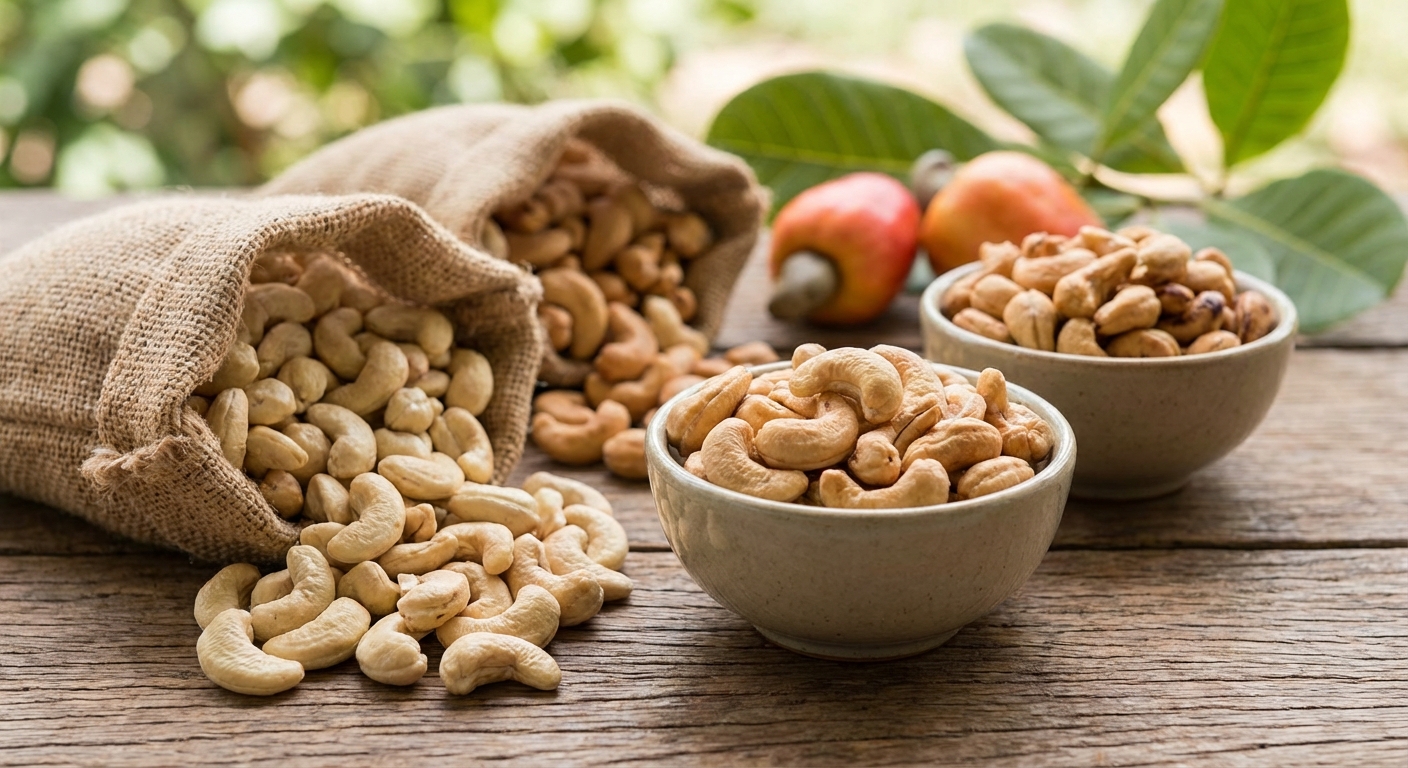
The cashew nut is now one of the most traded tree nuts in the world, consumed from Abidjan to Shanghai and priced daily on commodity exchanges. Yet its journey from a forgotten corner of the South American tropics to a global food staple is a story of Portuguese colonialism, deliberate agricultural transfer and the industrial rise of India and Vietnam as processing powerhouses.
Botanical Origin: The Cerrado of Northeast Brazil
The cashew tree, Anacardium occidentale, is native to the coastal and cerrado regions of northeastern Brazil — principally the states of Ceará, Rio Grande do Norte and Piauí. Pre-Columbian Tupí and Tupi-Guaraní peoples ate the cashew apple (the swollen peduncle) fresh, fermented it into a beverage called cauim, and consumed the nut, though their primary interest was the fruit rather than the kernel.
Portuguese explorers encountered the cashew in the 1560s and documented it extensively. The botanical name Anacardium refers to the heart-shaped profile of the kernel when viewed from above (Greek: ana = upward, kardia = heart). The “nut” is botanically a seed — it hangs outside the cashew apple rather than inside it — attached to the bottom of the swollen peduncle by a short stem.
The Cashew Apple and Cashew Shell Liquid
Two by-products of the cashew deserve mention for industrial buyers:
- Cashew apple: The soft, astringent pseudo-fruit around the nut. Highly perishable; consumed fresh, juiced or fermented locally in Brazil, Mozambique and parts of West Africa. Rarely exported due to a shelf life measured in days.
- Cashew Nut Shell Liquid (CNSL): The toxic resinous oil between the inner and outer shell. Rich in anacardic acid, cardanol and cardol. A significant industrial feedstock for brake linings, surface coatings, polymer resins and anti-fouling paints. Exported separately from kernel processing.
Portuguese Transfer: The 16th-Century Global Spread
Portuguese maritime traders introduced the cashew to their trading posts in Goa (India) around 1560–1570, then to East and West Africa in the decades that followed. The motivation was initially reforestation and anti-erosion management in coastal sandy soils — the cashew’s drought tolerance and rapid canopy growth made it useful for stabilising dunes — rather than commercial food production.
From Goa, cashew cultivation spread across coastal India to Karnataka, Kerala and Andhra Pradesh. From Portuguese East Africa (Mozambique), it spread north along the coast. The Mozambican cashew industry would eventually become the world’s largest in the mid-20th century before collapsing after independence.
20th Century: The Rise of West Africa
Today, the West African Cashew Belt — spanning Côte d’Ivoire, Guinea-Bissau, Ghana, Benin, Tanzania and Nigeria — accounts for approximately 45–50 % of global raw cashew nut (RCN) production. The trajectory is recent:
- Guinea-Bissau was the pioneering West African exporter, with significant production from the 1970s.
- Côte d’Ivoire surpassed India as the world’s top RCN exporter in the mid-2000s. In a recent crop year it exported over 800,000 MT of RCN — more than any other country.
- Tanzania has grown substantially, supported by the Tanzania Cashewnut Board’s quality grading system.
The West African cashew tree is typically ungrafted Anacardium occidentale seedling stock, producing small-to-medium kernels with outturn rates of 44–50 lbs per 80-kg bag. Improved dwarf hybrid varieties are being introduced to raise yields and shorten the juvenile period from 3–5 years to 18 months.
India and Vietnam: The Processing Giants
India — particularly Kollam (Quilon) in Kerala — was the industrial processing capital of the world from the 1950s through the 2000s. The industry is characterised by small family-run units and cooperative processing halls employing predominantly women workers. Indian processing technology developed the standard methods: roasting the shell to extract CNSL, cooling, cracking, peeling and grading.
Vietnam has been the dominant processed kernel exporter since around 2013. Vietnamese processors import raw nuts from West Africa and Cambodia, run large-scale mechanised factories with high throughput, and export to the US, EU and China. Vietnam’s efficiency advantage comes from scale and mechanisation — the country processes over 1 million MT of RCN per year.
The trade flow is therefore:
West African farms (RCN) → shipped to Vietnam/India → processed → exported to consumer marketsCashew Grades and Kernel Classification
Processed cashew kernels are graded by size, colour and integrity. The international standard is the W-grade system:
| Grade | Description | Count per lb |
|---|---|---|
| W-180 | King — largest, pale, whole | ~180 |
| W-210 | Jumbo — very large, whole | ~210 |
| W-240 | Large — standard export grade | ~240 |
| W-320 | Medium — highest-volume grade | ~300–320 |
| W-450 | Small whole | ~450 |
| SW/DW/LWP | Splits, dessert pieces, large pieces | — |
W-320 is by far the most traded grade, representing approximately 55–60 % of global kernel exports. Colour grades run from “Scorched Wholes” (SW) at the premium end to “Desert Wholes” (DW) for slightly discoloured but intact kernels.
Growing Conditions and Seasonality
Anacardium occidentale performs best in:
- Temperature: 20–35 °C; sensitive to frost.
- Rainfall: 600–4,500 mm annually, with a defined dry season during flowering and nut set. Rainfall during the flowering period (December–February in West Africa) directly impacts yields.
- Soil: Well-drained sandy or laterite soils, pH 5–6.5. Tolerates poor soils where other crops fail.
The West African harvest runs approximately March through June, with Côte d’Ivoire peaking in April–May. This creates a predictable export window and drives seasonal price movements on the Rotterdam RCN market.
Environmental and Sustainability Dimensions
Cashew production faces mounting scrutiny on two fronts:
Deforestation: In Côte d’Ivoire, cashew orchards expanded into cocoa and forest zones during the 2000s and 2010s. The rapidity of expansion in Guinea-Bissau has also been linked to forest clearance.
Processing labour conditions: Reports of hazardous working conditions (CNSL exposure causing chemical burns) in artisanal Indian processing units have led major buyers to require supplier audits. Mechanised Vietnamese factories generally have better occupational health profiles.
For buyers concerned with responsible sourcing, certification schemes available include Fairtrade, Rainforest Alliance and Organic (particularly from Guinea-Bissau cooperatives). CarverAgri can source certified RCN and processed kernels with full chain-of-custody documentation.
Sourcing Cashews: What Buyers Need to Know
For industrial buyers and trading houses, the key procurement decisions are:
- RCN vs. processed kernel: Buying RCN gives price exposure to the West African harvest. Buying W-grade kernels shifts processing risk to India or Vietnam.
- Outturn rate: A bag’s outturn (lbs of kernel per 80-kg bag of RCN) determines effective kernel cost. Typical Ivorian RCN: 46–50 lbs. Guinea-Bissau: 50–56 lbs (higher due to larger nut size).
- Aflatoxin certification: EU imports require aflatoxin B1 ≤ 5 ppb and total aflatoxins ≤ 10 ppb. Sampling at origin and at port of entry is standard.
- Incoterm: RCN typically traded FOB Abidjan, Dakar or Bissau. Processed kernels from India/Vietnam typically CIF Rotterdam or CIF Houston.
Explore our Cashew Nuts product page for current grade specifications and availability, or contact us directly for a volume quote.
Conclusion
The cashew’s journey from the cerrado of Ceará to the supermarket shelves of Europe and the snack bars of Shanghai spans five centuries of agricultural transfer, industrial development and global trade. Today it is a commodity shaped by West African climate, Vietnamese processing capacity and the dietary preferences of a growing global middle class. For procurement teams, understanding the origin geography, processing chain and quality grading system is the first step toward securing a reliable, cost-effective supply.